Vehicle planning guide
Sprinter van rentals for 7–14 passengers
A sprinter van is usually best for a group of roughly 7–14 passengers that values a compact vehicle for airport, executive, wedding-party, or point-to-point transportation. The critical constraint is often luggage rather than seats: a full passenger load with checked bags can exceed the assigned van's storage. Confirm the seating layout, belts, luggage plan, accessibility, interior height, climate control, Wi-Fi, and power in writing.
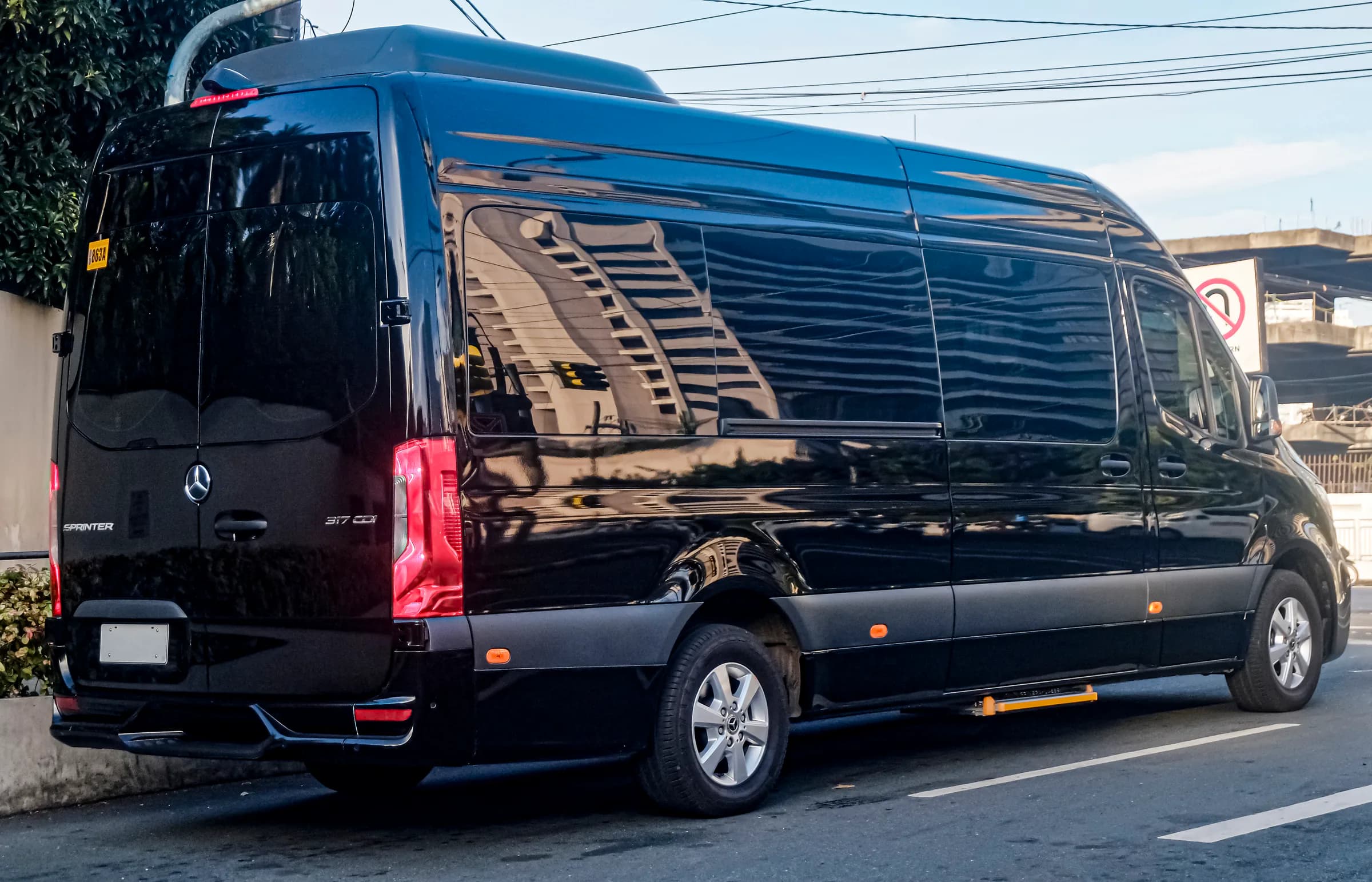
Passenger capacity and fit
Typically 7–14 passengers. That range is the starting point. The right fit also depends on the seating layout, baggage, mobility devices, and any equipment traveling with the group.
- Count every rider, including an escort, coordinator, guide, or staff member who may travel with the group.
- Size the vehicle from passengers and belongings together; the highest-capacity seating layout may not leave the storage your group needs.
- Confirm whether quoted capacity counts the driver and what passenger seating remains in the assigned configuration.
- If ridership can exceed the confirmed capacity, price a larger category or an additional vehicle before the service date.
Trips this category commonly fits
| Use case | Why it can fit |
|---|---|
| Executive and client transportation | A compact vehicle can keep a small party together for airport, hotel, office, and meeting movements without reserving a larger bus. |
| Small airport transfers | A van can be efficient for one flight group when the passenger and luggage inventory fit the assigned storage. |
| Wedding party and family movements | It can connect a small party among a hotel, ceremony, photo stop, and reception on one coordinated itinerary. |
| Short point-to-point service | A smaller footprint may suit local pickups where a coach would be unnecessary, provided the commercial loading area accepts the vehicle. |
Luggage is its own constraint
Vehicle capacity does not tell you whether every bag, mobility device, instrument, stroller, or piece of event equipment will fit safely.
- Sprinter luggage capacity is limited and layout-dependent. A 14-passenger seating arrangement does not prove that 14 passengers' checked bags will fit.
- Separate checked bags, carry-ons, strollers, golf clubs, instruments, mobility devices, and presentation equipment in the quote request.
- Ask where luggage will be stored and whether any seats must remain unused; do not plan to place loose items in the aisle or exit path.
- For airport groups with substantial luggage, a minibus or coach may be a safer fit even when the sprinter has enough seats.
What's actually on board?
Start with what the trip needs, then put every must-have item in the quote request—from a restroom or power outlets to a lift or luggage bay.
| Amenity | Planning note |
|---|---|
| Seating layout and seat belts | Confirm forward-facing versus bench seating, the number of passenger positions, and belts on the assigned vehicle. |
| Wi-Fi and power | These may be request-only upgrades. Put required connectivity and outlet types in writing. |
| Climate control | Confirm passenger-area heating and cooling, especially for extreme weather or groups wearing formal attire. |
| Executive finish | Leather, lighting, privacy, tables, and other premium interior features vary; request only what matters and confirm it specifically. |
| Accessible boarding equipment | Do not assume a van is accessible because it is smaller. Confirm the lift or ramp, entrance, securement, seating, and mobility-device storage configuration. |
Accessibility planning
Include functional transportation needs with the itinerary so the provider can match the vehicle and evaluate each loading location.
- Does anyone need a ramp, lift, step-free boarding, boarding assistance, or a particular seating arrangement?
- What mobility device will travel, and what are its dimensions, weight, battery type, and folding capability?
- Can the assigned van secure the device while preserving enough seats and luggage space for the rest of the group?
- Is there an accessible, unobstructed loading path at every curb, garage, hotel, office, and venue?
- Does anyone need additional entrance clearance, transfer time, seating support, or storage for assistive equipment?
Can the vehicle handle the route?
| Constraint | What to plan |
|---|---|
| Garage and canopy clearance | A tall passenger van may not fit every parking garage, porte-cochère, or loading structure. Obtain the assigned vehicle's clearance needs before directing it inside. |
| Commercial pickup rules | Airports and venues may assign vans to commercial transportation zones rather than ordinary passenger-car curbs. |
| Passenger and luggage loading | Allow enough curb time and space for rear or side-door loading without blocking traffic, bicycle lanes, sidewalks, or accessible routes. |
| Interstate operating requirements | For compensated interstate service, federal requirements can apply to 9–15-passenger vehicles, including the driver. Verify the actual operating carrier rather than assuming a van is unregulated. |
Nearby alternatives
| Alternative | When to choose it | Tradeoff |
|---|---|---|
| Minibus | Move up when the group, checked luggage, mobility devices, or equipment cannot fit comfortably in a confirmed van configuration. | A minibus adds seats and may add storage, but it requires more curb and parking space and may cost more. |
| Full-size coach | Use a coach for a large party, substantial luggage, long-distance trip, or itinerary where a restroom and underfloor storage are priorities. | A coach offers much more capacity but has the largest operating footprint and stricter route and venue-access needs. |
| School bus | A school bus is an alternative for a larger, budget-oriented local group that does not need an executive interior or dedicated luggage space. | It can move more people locally, but the experience and amenity profile are much more basic. |
What changes the quote?
For early planning, use roughly $100–$200 per hour or $900–$1,200 per day across charter vehicle categories. Charter pricing follows the complete itinerary, duty time, assigned equipment, and local supply—not passenger capacity alone.
| Factor | Potential impact |
|---|---|
| Minimum service window | A short transfer can still be priced around a provider minimum that includes vehicle positioning, loading, and return travel. |
| Passenger-and-luggage fit | A larger van layout, an additional vehicle, or a minibus may be required once the provider reviews bags and equipment. |
| Executive or accessible configuration | Specialized interiors, connectivity, boarding equipment, or securement positions can narrow availability and affect cost. |
| Airport, toll, parking, and waiting charges | Commercial access fees, tolls, parking, delayed-flight waiting, and extra stops should be addressed in the written quote. |
| Date, pickup market, and lead time | Peak event dates, remote pickup areas, and last-minute requests may require the vehicle to be positioned from farther away. |
Details to include in the quote request
- Exact pickup, intermediate stops, destination, and return addresses
- Date, report time, loading time, departure time, and final release time
- Total passenger count, including staff or escorts
- Separate count and description of all bags, equipment, strollers, and mobility devices
- Required seating layout, belts, accessible equipment, and securement positions
- Required Wi-Fi, outlets, climate control, privacy, or executive features
- Flight, terminal, hotel, office, venue, garage, and commercial-loading instructions
- Whether the vehicle waits, parks, returns later, or makes repeated transfers
Common questions
How many passengers fit in a sprinter van?
The category is typically 7–14 passengers. Confirm the assigned van's passenger seating and whether the quoted capacity counts the driver, especially when accessibility equipment or substantial luggage is involved.
Can 14 passengers and their airport luggage fit?
Not necessarily. The highest seating layout may leave limited luggage space. Send the provider a separate bag and equipment inventory and ask it to confirm the actual loading plan.
Do sprinter vans have seat belts?
American Charterlines lists seat belts for this category, but the reservation should still confirm the assigned vehicle's seating and belt configuration in writing.
Can a sprinter van enter a hotel parking garage?
Do not assume it can. Passenger vans can be taller than ordinary cars, and roof equipment can matter. Compare the assigned vehicle's clearance requirement with the hotel's posted and confirmed limit.
Are commercial sprinter vans regulated like buses?
Requirements depend on the vehicle, capacity, compensation, route, and operation. FMCSA states that federal oversight can apply to compensated interstate operations using vehicles designed or used for 9–15 passengers, including the driver. Verify the actual carrier's authority and records.
Sources and official links
These are the government, airport, transportation authority, venue, and provider pages used for the guide. Check the linked page for the latest operating details.
- 7 to 14 passenger sprinter van — American Charterlines
- Vehicle category overview — American Charterlines
- Small passenger-carrying vehicles — Federal Motor Carrier Safety Administration
- Look Before You Book — Federal Motor Carrier Safety Administration
- SAFER Company Snapshot — Federal Motor Carrier Safety Administration
- Licensing and insurance requirements for for-hire passenger carriers — Federal Motor Carrier Safety Administration
- Accessibility for over-the-road buses — Federal Motor Carrier Safety Administration