Vehicle planning guide
Full-size coach bus rentals
A full-size coach is usually the strongest fit for a group of roughly 40–56 passengers, a luggage-heavy airport movement, or a long-distance itinerary. Its main advantages are a larger passenger cabin, underfloor luggage storage, and comfort features suited to longer trips. Do not reserve by seat count alone: confirm the assigned coach's usable capacity, luggage volume, restroom, accessibility equipment, seat belts, Wi-Fi, power, and venue access in writing.
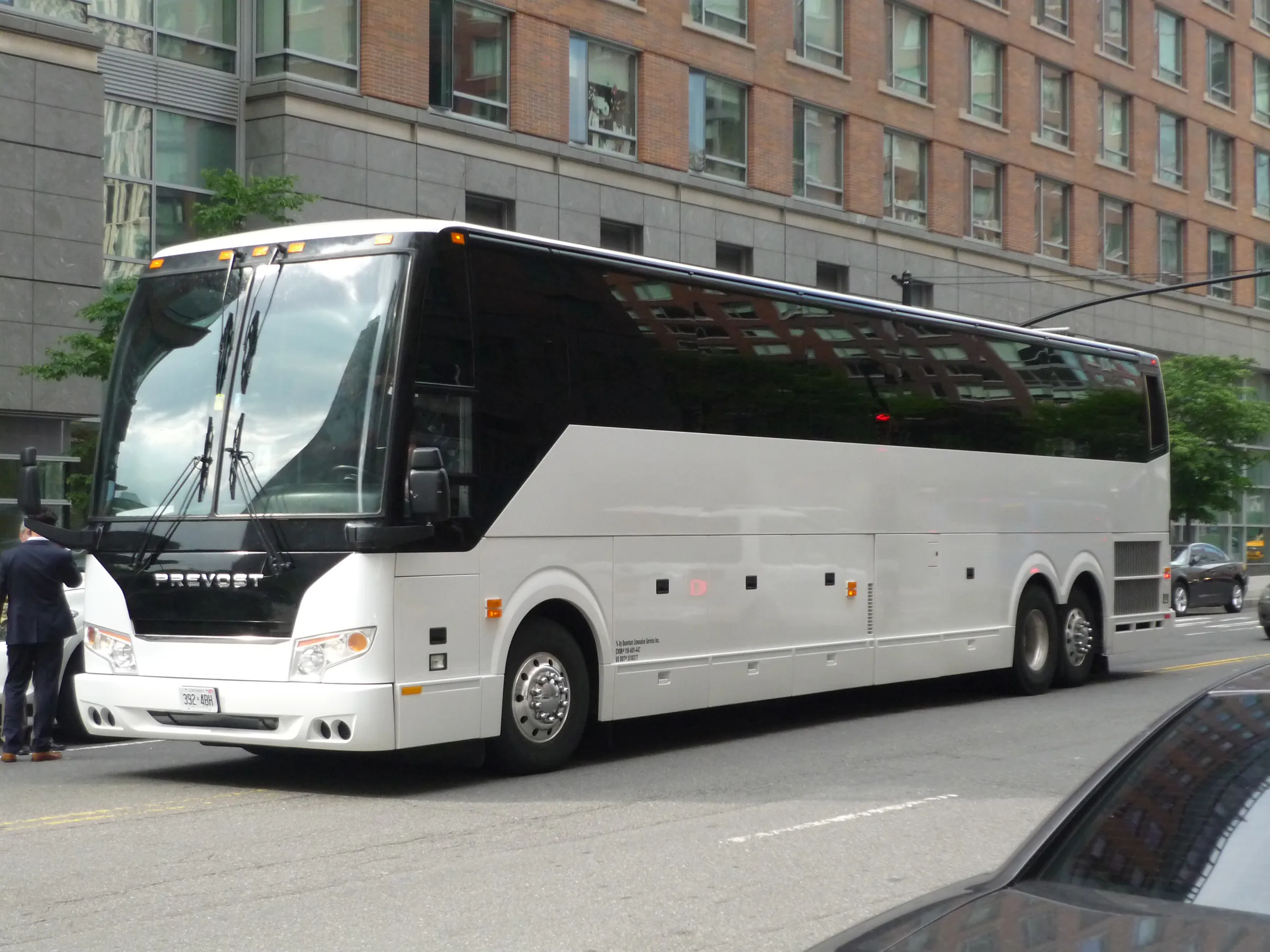
Passenger capacity and fit
Typically 40–56 passengers. That range is the starting point. The right fit also depends on the seating layout, baggage, mobility devices, and any equipment traveling with the group.
- Use the actual peak ridership, not the invited headcount or an average across shuttle runs.
- Keep a margin for last-minute attendees when the guest list is not final; an over-capacity vehicle cannot be solved at pickup.
- Tell the provider how many passengers use mobility devices or need step-free boarding because the accessible configuration and usable seating must be confirmed together.
- For a multi-vehicle program, give ridership by departure wave so the provider can evaluate one coach, several coaches, or a mixed fleet.
Trips this category commonly fits
| Use case | Why it can fit |
|---|---|
| Intercity and multi-day travel | The passenger cabin and underfloor storage are better suited to long mileage, rest stops, and overnight luggage than smaller categories. |
| Conferences and large event movements | One coach can consolidate a large arrival or departure wave when the venue has a legal motorcoach loading plan. |
| Airport and cruise transfers with luggage | Underfloor bays are generally more useful than the limited rear or interior storage found on smaller vehicles. |
| Teams, tours, and performance groups | A full-size coach may be the better starting point when passengers also bring equipment, instruments, uniforms, or multiple bags. |
Luggage is its own constraint
Vehicle capacity does not tell you whether every bag, mobility device, instrument, stroller, or piece of event equipment will fit safely.
- Underfloor bays are not unlimited. Count checked bags, carry-ons, mobility devices, instruments, coolers, skis, golf clubs, and equipment separately.
- Ask for usable storage dimensions or a provider review when the group has oversized or unusually shaped items; a bag count alone can be misleading.
- Items needed during the trip must fit safely in the passenger cabin without blocking aisles, exits, or securement areas.
- Accessible mobility devices may require priority handling and can change how remaining luggage is loaded. Describe each device early without disclosing an unnecessary diagnosis.
What's actually on board?
Start with what the trip needs, then put every must-have item in the quote request—from a restroom or power outlets to a lift or luggage bay.
| Amenity | Planning note |
|---|---|
| Onboard restroom | Common on many full-size coaches, but not universal. Confirm it on the assigned vehicle and keep appropriate service stops in the itinerary. |
| Wi-Fi and power | Request each feature explicitly and treat connectivity as a convenience, not a guaranteed substitute for cellular service or critical work systems. |
| Seat belts | Availability and configuration vary. If belts are required by the group or organization, make that a written vehicle requirement. |
| Reclining seats, climate control, and audiovisual equipment | Confirm the features that matter rather than relying on a generic coach description or stock photo. |
| Lift or other accessible boarding equipment | Request accessible service as early as possible and confirm the boarding device, securement positions, and accessible path at every stop. |
Accessibility planning
Include functional transportation needs with the itinerary so the provider can match the vehicle and evaluate each loading location.
- Does anyone need a lift, ramp, step-free boarding, boarding assistance, or a particular seat location?
- How many mobility devices will travel, and what are their dimensions, weight, battery type, and whether they fold?
- How many wheelchair securement positions are required on the same vehicle, and how does that configuration affect usable passenger seating?
- Can each pickup and destination provide a level, unobstructed accessible loading path with enough space to deploy the boarding equipment?
- Will service animals, portable oxygen, or other assistive equipment travel, and what handling details should the operator plan for?
Can the vehicle handle the route?
| Constraint | What to plan |
|---|---|
| Motorcoach access | A coach may be prohibited from parkways, weight- or height-restricted roads, tight private drives, or low-clearance structures. Give exact addresses and let the operator select the legal route. |
| Loading and parking | A legal passenger-loading zone is not necessarily a waiting or parking location. Confirm separate drop-off, staging, parking, and return-pickup instructions. |
| Driver schedule | Long days and multi-day trips must fit applicable hours-of-service rules. The provider may require a second driver, schedule adjustment, or overnight lodging. |
| Venue and airport permits | Airports, convention centers, campuses, stadiums, and ports may require commercial permits, assigned gates, dispatch procedures, or event-specific passes. |
Nearby alternatives
| Alternative | When to choose it | Tradeoff |
|---|---|---|
| Minibus | Choose a minibus when the group and luggage fit comfortably and the trip is primarily local or shuttle-based. | A minibus may be easier to place at constrained stops, but storage, restroom availability, and long-distance comfort vary more. |
| Sprinter van | Choose a sprinter van for a small executive group, compact airport party, or short point-to-point movement. | It is more nimble, but it has much less passenger and luggage capacity and normally lacks a restroom. |
| School bus | Consider a school bus for a budget-focused, short local trip when premium amenities and luggage bays are unnecessary. | A school bus is generally more basic and less suitable for long distances, substantial luggage, or groups requiring coach-style amenities. |
What changes the quote?
For early planning, use roughly $100–$200 per hour or $900–$1,200 per day across charter vehicle categories. Charter pricing follows the complete itinerary, duty time, assigned equipment, and local supply—not passenger capacity alone.
| Factor | Potential impact |
|---|---|
| Trip time and mileage | The complete duty window, deadhead travel, route mileage, waiting time, and whether the coach remains with the group all shape the quote. |
| Pickup market and availability | A coach may need to travel from another operating base, especially for remote pickups, peak dates, or specialized equipment. |
| Season and lead time | High-demand weekends, school travel periods, conventions, and last-minute requests can reduce availability and increase price. |
| Tolls, parking, permits, and lodging | Ask whether each item is included, estimated, or billed later. Overnight itineraries may also require an individual room and coach-compatible parking for each driver. |
| Required configuration | An accessible coach or a vehicle with specific connectivity, power, seating, or restroom features may have a different availability and positioning cost. |
Details to include in the quote request
- Exact pickup, every intermediate stop, destination, and final release location
- Service date, vehicle report time, passenger loading time, departure time, and expected release time
- Peak passenger count and ridership by wave or shuttle loop
- Separate inventory of ordinary bags, oversized items, equipment, and mobility devices
- Required accessibility equipment and number of securement positions
- Essential amenities, including restroom, seat belts, Wi-Fi, outlets, or audiovisual equipment
- Venue, hotel, airport, campus, or event loading instructions already supplied to the group
- For overnight service, the lodging and parking plan for the driver and vehicle
Common questions
How many people fit on a full-size charter bus?
The working category is typically 40–56 passengers. The exact assigned coach may differ, and an accessible configuration can affect usable seating, so confirm the final capacity in writing.
Does every full-size coach have a restroom?
No universal amenity should be assumed. Many coaches have an onboard restroom, but the reservation should identify it as required and the written confirmation should describe the assigned vehicle.
How much luggage can a coach carry?
Full-size coaches generally offer the strongest luggage capacity in these four categories, but storage depends on the vehicle and the size and shape of the items. Send a separate inventory for bags, mobility devices, instruments, and equipment.
Can a full-size coach make several city stops?
Often, if each road and stop can legally and physically accommodate it. Give the provider exact addresses and venue instructions so it can review restrictions, curb access, parking, timing, and the driver schedule.
Can I request a wheelchair-accessible coach?
Yes. Request accessible service as early as possible and specify the boarding assistance, equipment, and number of securement positions needed. The provider should confirm both the vehicle configuration and an accessible loading path at every stop.
Sources and official links
These are the government, airport, transportation authority, venue, and provider pages used for the guide. Check the linked page for the latest operating details.
- 40 to 56 passenger deluxe coach bus — American Charterlines
- Vehicle category overview — American Charterlines
- Look Before You Book — Federal Motor Carrier Safety Administration
- SAFER Company Snapshot — Federal Motor Carrier Safety Administration
- Accessibility for over-the-road buses — Federal Motor Carrier Safety Administration
- Hours of service for motor carriers of passengers — Federal Motor Carrier Safety Administration
- Licensing and insurance requirements for for-hire passenger carriers — Federal Motor Carrier Safety Administration